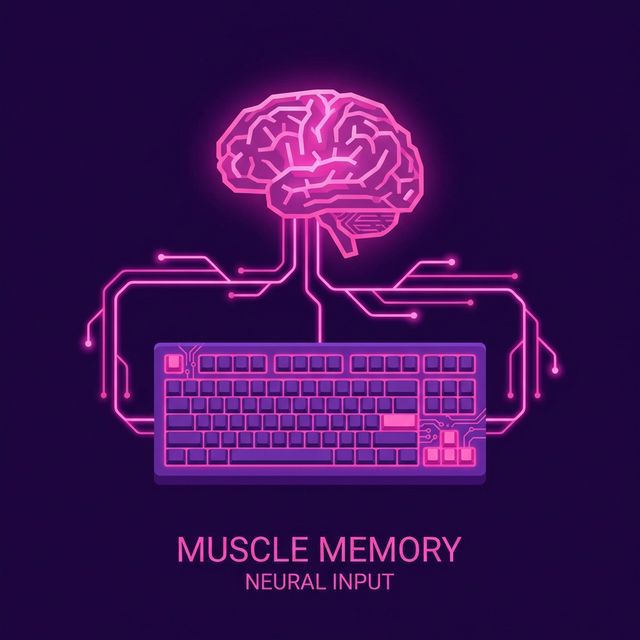
When a skilled programmer is "in the zone," typing feels less like pressing buttons and more like thinking directly onto the screen. This feat of human engineering is powered by what we colloquially call "muscle memory."
But your muscles don't actually have memories. So what exactly is happening in your brain when you touch type?
The Neuroscience of Procedural Memory
When you first learn a new skill—like finding the { key—the action is controlled by the prefrontal cortex, the area of the brain responsible for conscious thought and decision-making.
This process is slow, deliberate, and consumes a massive amount of mental energy. This is why beginners feel exhausted after a 15-minute typing lesson.
However, as you repeat the action, your brain begins to transfer the instruction manual from the prefrontal cortex to the basal ganglia and the cerebellum. These deeper brain structures handle procedural memory—the unconscious automation of complex motor tasks (like riding a bike or typing).
The Myelin Sheath
As the signals travel down the same neural pathways over and over, your brain responds by wrapping those specific neurons in a fatty substance called myelin.
Myelin acts exactly like insulation on a copper electrical wire. Bare neurons transmit signals at about 2 mph. Heavily myelinated neurons transmit signals at up to 200 mph.
This is the physical, biological reality behind "muscle memory." You physically rewire your brain to transmit typing commands 100 times faster.
Why Practice Makes Permanent, Not Perfect
Here is the catch: Myelin doesn't know the difference between good technique and bad technique.
If you practice typing while looking down at your hands, or using only your index fingers, your brain will gleefully wrap those inefficient, error-prone neural pathways in myelin. You will become exceptionally fast at typing incorrectly.
To break a bad habit, you have to build an entirely new neural pathway to replace the old one.
How to Optimize Your Learning
- Slow down to speed up: When learning touch typing on TypeNCode, prioritize 100% accuracy over speed. You want to myelinate the correct pathways.
- Sleep on it: Myelin is primarily laid down while you sleep. A 15-minute practice session followed by a good night's sleep is vastly superior to a 3-hour marathon practice session.
- Consistency: Daily repetition tells your brain, "This pathway is important, insulate it." Skip three days, and the brain stops the myelination process.