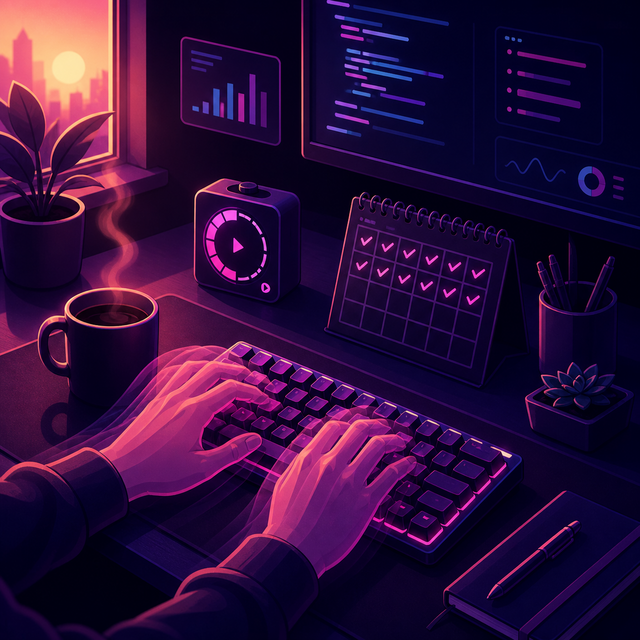
Most developers improve their typing in bursts. They discover a typing test, grind for an hour, feel their fingers get clumsy, then forget about practice until the next time a slow command or typo breaks their flow.
That pattern does not build skill. It builds frustration.
Typing improves fastest when it becomes a small, repeatable part of your development routine. You do not need a giant training block. You need a simple loop that tells your brain, every day, "this movement matters."
Start with a Tiny Commitment
The best typing routine is one you can actually repeat on a busy day.
Start with 10 minutes per day. That is enough time to warm up your hands, practice deliberately, and stop before fatigue teaches your fingers sloppy habits.
If 10 minutes feels too easy, that is the point. A routine should feel almost boring at first. Once the habit is automatic, you can increase the difficulty without negotiating with yourself every morning.
Use the Same Sequence Every Day
Random practice can be fun, but a routine needs structure.
Try this simple developer-focused sequence:
- Two minutes of slow accuracy: Type below your normal speed and aim for 100% accuracy.
- Four minutes of coding syntax: Practice braces, quotes, semicolons, indentation, and common language patterns.
- Three minutes at natural speed: Let your fingers move comfortably while keeping errors low.
- One minute review: Notice the keys or patterns that caused hesitation.
This gives you a complete loop: control, coding specificity, speed, then feedback.
Track Accuracy Before WPM
WPM is motivating, but it is also noisy. Sleep, stress, caffeine, and the difficulty of the text can all move your score around.
Accuracy is a cleaner signal. If your speed rises while your accuracy stays above 98%, your technique is getting stronger. If your WPM rises but your accuracy drops, you are probably training panic.
On TypeNCode, treat accuracy as your gatekeeper. Speed is allowed to climb only when accuracy comes with it.
Practice What You Actually Type
Developers do not type only plain English. We type command-line flags, object properties, function calls, HTML tags, and error messages.
That means a useful routine should include real syntax:
- JavaScript object literals
- Python function definitions
- HTML attributes
- PHP variables and arrows
- Go structs and method calls
The goal is to make common coding patterns feel as automatic as common words.
Stop Before Your Hands Get Messy
Fatigue is sneaky. At first, you feel warmed up. Then your fingers start landing late, your shoulders rise, and your error rate climbs.
Do not push through that phase during typing practice. You are not trying to prove endurance. You are trying to repeat clean movements often enough that they become automatic.
End the session while you still feel controlled. That makes it easier to come back tomorrow.
Make the Routine Part of Your Workday
The easiest time to practice is right before you start coding.
Open your editor, start your coffee, then do one short typing session before touching the real codebase. This turns practice into a warmup instead of an extra task.
After a few weeks, the benefit becomes obvious: fewer corrections, calmer hands, and less friction between thought and code.
Daily typing practice is not glamorous. It is just one of those small developer habits that quietly compounds until your keyboard starts to disappear.